



Yes. You may qualify for an ESA for depression if you have never seen a psychiatrist. A state-licensed mental health professional can evaluate your mental health needs and determine whether an emotional support animal is right for you.
Depression can affect a lot of things. It can change the way you sleep and work, as well as how you care for yourself and manage everyday responsibilities. Living with an animal brings comfort and a constant source of companionship and structure for some people.
According to the National Institute of Mental Health (NIMH), 8.3% of U.S. adults experienced at least one major depressive episode in 2021, affecting an estimated 21 million people. The rate was higher among females (10.3%) than males (6.2%), and adults aged 18–25 had the highest prevalence at 18.6%.
But does having depression automatically mean you qualify for an emotional support animal? The answer is no. Of course, depression can be relevant to an ESA evaluation, but mere symptoms do not make anybody eligible for an ESA.
What Is Depression and How It Can Impact Your Daily Life?
Depression is a mental health condition that affects how a person thinks, feels, and handles daily tasks. It may cause persistent sadness, low energy, loss of interest in activities, difficulty concentrating, and changes in sleep or appetite.
According to the National Institute of Mental Health (NIMH), depression can interfere with everyday activities, relationships, and work. It can also make it harder to maintain personal hygiene, manage household responsibilities, or stay connected with others. The severity of these effects varies from person to person, and symptoms may last for weeks or longer.

Can Depression Qualify You for an ESA?
Depression can absolutely be part of ESA eligibility. But the question isn’t “do I have depression?” It’s whether depression is actually making daily life harder in ways an animal could help with. Depression is one of several conditions that may qualify for an ESA, but qualification always depends on an individual evaluation.
Under the Fair Housing Act, an ESA can count as a reasonable accommodation if it helps ease the effects of your condition. So if depression is showing up as low energy or motivation, or struggling to keep up with basic household management and hygiene routines, that’s worth bringing up during your evaluation.
That said, not everyone qualifies just because they’re dealing with depression. It comes down to your specific situation and what your evaluator determines as far as symptoms and debilitation.
“For some people with depression, an emotional support animal can bring comfort, connection, and a sense of stability to everyday life.” – Leslie K. Gamble, Licensed Independent Clinical Social Worker
Depression Is Not an Automatic ESA Qualification
This is one of the biggest misconceptions people have about emotional support animals. A diagnosis alone doesn’t hand you an automatic right to an ESA letter. And just owning a pet doesn’t turn that pet into an ESA either.
A licensed mental health professional has to actually determine whether an ESA makes clinical sense for you, your diagnosis, and your life. That means looking at your symptoms, how they’re affecting your daily life, your treatment history, and what role the animal would realistically play in supporting you. Depression can also occur alongside other conditions, such as PTSD, and a clinician will consider your whole situation.
Basically, diagnosis, how it’s impacting you, and a real need for animal emotional support adds up to something a clinician needs to evaluate, not a formula that guarantees approval.
This is also exactly why legitimate evaluations look so different from sites promising instant approval with no real assessment involved. The evaluation should be tailored to you and your life, and the ESA letter will be specific to you, your symptoms, and your ESA.
You can see what a legitimate ESA letter looks like to understand what a real evaluation produces.
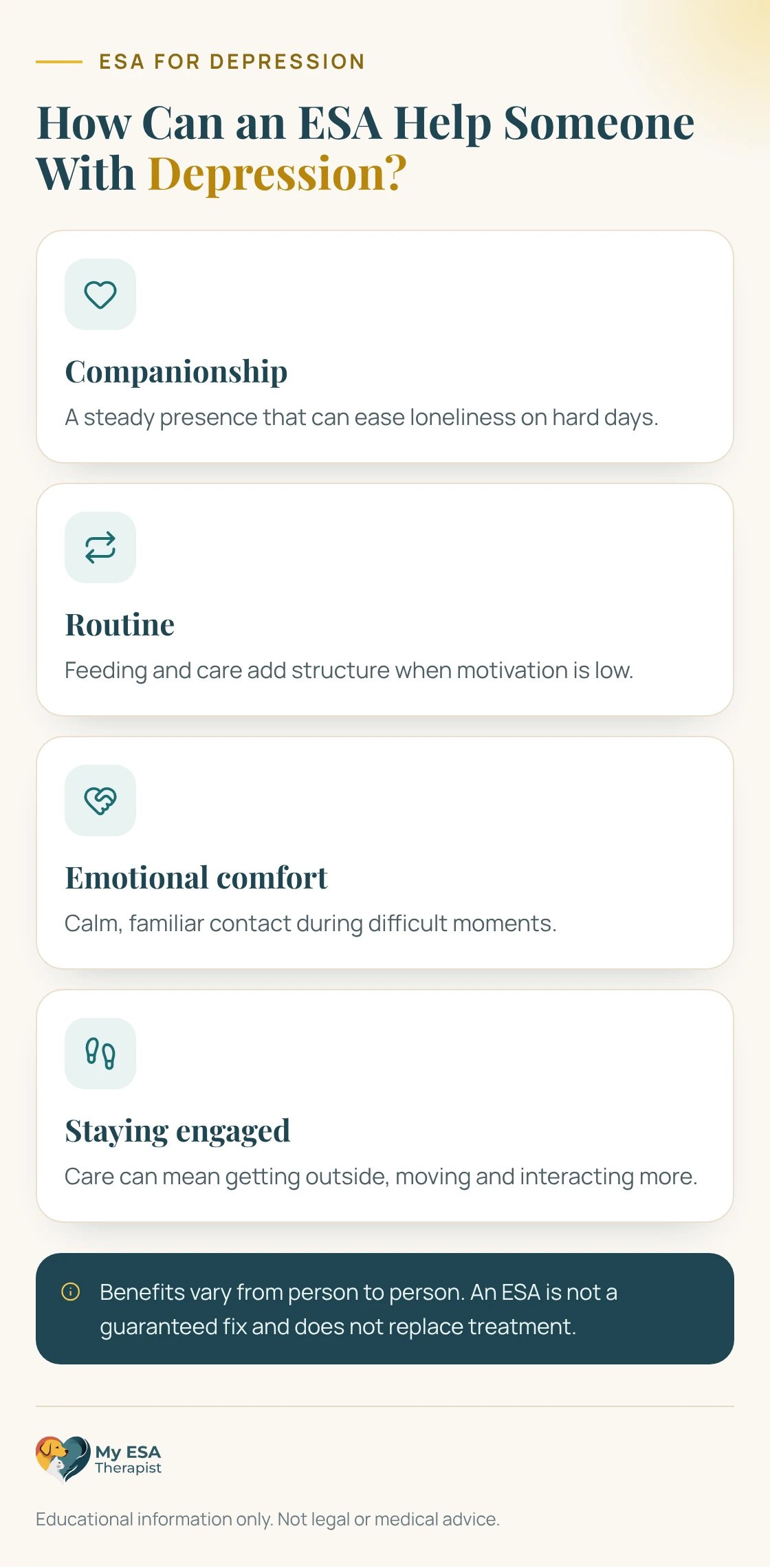
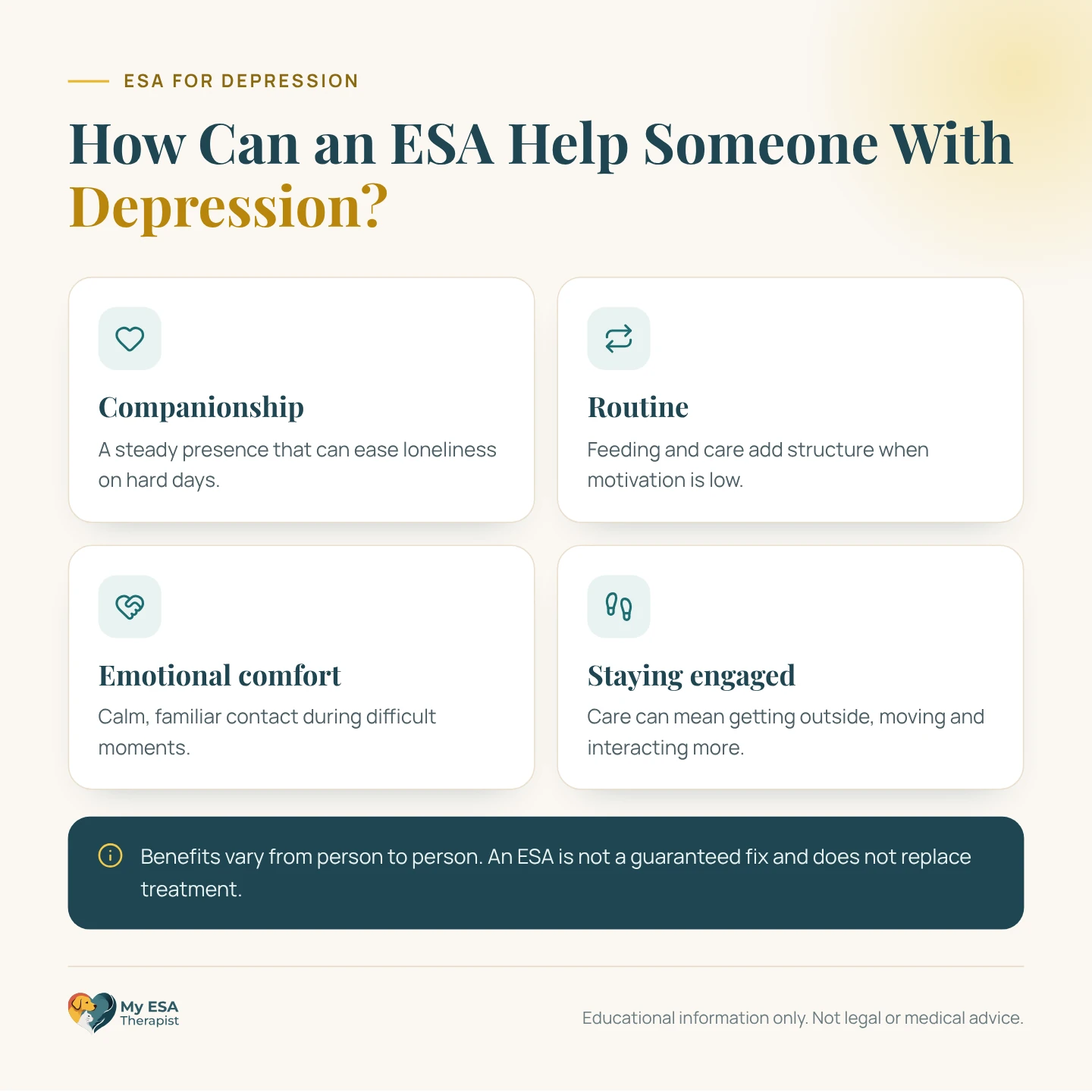
How Can an ESA Help Someone With Depression?
An ESA isn’t a treatment for depression on its own, and it’s not a substitute for therapy, medication, crisis care, or anything else your doctor has recommended. But for some people, having an animal around does offer real support in a few ways.
Companionship
Depression has a way of making isolation feel heavier than it already is. An animal gives you steady company without the pressure of the social interaction that human relationships usually require. Animal companionship can be a source of emotional connection and reduce feelings of loneliness.
Routine
Animals need regular care, feeding, walks, grooming, etc. Keeping up with daily ESA care can bring some structure back into your day, which matters a lot when energy and motivation are hard to come by. With depression, it can be difficult to do things for yourself, but doing tasks for another living being can add to motivation.
Emotional Comfort
Just having an animal nearby can be genuinely comforting during hard moments. For a lot of people, physical closeness and companionship make them feel less alone. ESAs can help with nervous system attunement through co-regulation. Many people with depression also experience symptoms of anxiety, and an ESA for anxiety may be evaluated in a similar way.
Encouragement to Stay Engaged
Depending on the animal, taking care of it might mean getting outside, moving around, or just interacting more with others. Those small things can pull you back into everyday life a bit.
Worth keeping in mind, though, these benefits vary person to person. An ESA shouldn’t be treated as a guaranteed fix for depression. It is not a ‘one size fits all’ intervention for depression management.
Does an ESA Give You Special Rights Everywhere?
No, and this can be confusing.
An ESA doesn’t come with the same public access rights as a service animal under the ADA. The ADA is actually pretty clear that animals whose job is limited to emotional support don’t count as service animals under its definition, so you can’t bring an ESA into restaurants, stores, or other public spaces on that basis. In other words, your ESA will not have protections to enter public spaces. ESAs are typically used for housing access only.
Housing works differently, though. The Fair Housing Act (FHA) outlines protections for Emotional Support Animals (ESAs) as an accommodation request in housing situations. An accommodation might look like an exception to a no-pets policy or getting a pet deposit or fee waived.
That said, ESA approval isn’t automatic just because you ask. FHA points to a few situations, like undue burden, fundamental alteration, direct threat, or significant property damage, where a housing provider can push back on the ESA request.
How to Get an ESA Evaluation for Depression?
If you are wondering whether you would qualify for an ESA, then the next step is talking to a licensed mental health professional.
Be honest during the evaluation about what you’re experiencing and your relationship with your animal. Talk through what actually changes when your animal is around and how their presence impacts your day-to-day life and disability management.
If the professional decides an ESA fits your situation, they’ll provide documentation based on their clinical judgment and whatever requirements apply in your state.
At My ESA Therapist, evaluations are done by licensed mental health professionals, not handed out automatically. The goal is to actually understand your situation before deciding whether an ESA recommendation makes sense for you.
The Bottom Line
Depression can be considered in an ESA evaluation, but the diagnosis alone isn’t what decides eligibility. What actually matters is the full picture: Your mental health and whether a licensed professional determines an ESA is appropriate for managing your mental health condition.
If your animal genuinely helps you manage what you’re going through, then an evaluation can help you figure out whether that support qualifies for a recommendation.
You don’t have to guess. A professional evaluation can give you a real answer.
Frequently Asked Questions About This ESA Topic
Answers from this article about eligibility, housing, and the evaluation.
01Can depression qualify me for an emotional support animal?
02Do I need an ESA letter if I already have a pet?
03Can an ESA help with depression?
04Can I take my ESA everywhere?
05Who can determine whether I qualify for an ESA?

Allyson Valley, Ph.D., LPC
Dr. Allyson Valley is a Licensed Professional Counselor with extensive clinical experience in mental health evaluation, emotional support animal assessments, and evidence-based psychotherapy.
Your Next Step
ESA documentation is issued only after an evaluation by a licensed professional. These pages explain the process and requirements.



- Evaluation by a clinician licensed in your state
- $99, no hidden fees
- Secure, HIPAA-compliant telehealth